
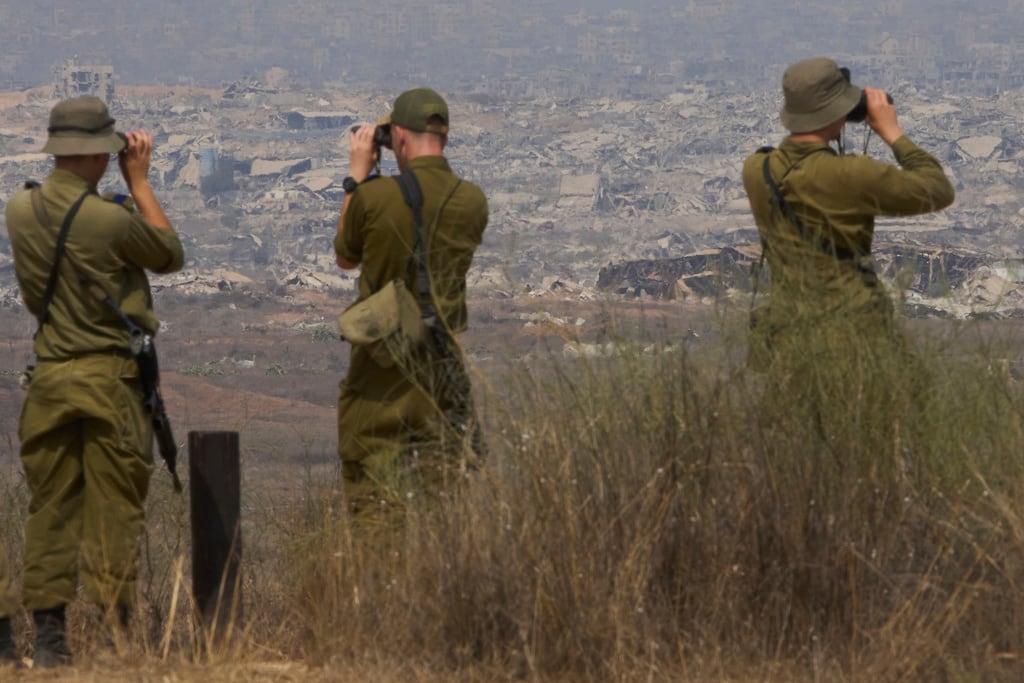
JERUSALEM (AP) Even as talks try to reach a truce between Israel and Hamas to end 22 months of fighting, Israel is getting ready to unleash a larger military assault in Gaza City, probably in the next few days.
On Wednesday, the Israeli military announced that the defense minister had approved plans to call up 60,000 reservists and extend the service of an additional 20,000 reservists to start a new phase of operations in some of Gaza’s most populated regions.
In Gaza, where the majority of the population has been uprooted, whole neighborhoods are in ruins, and people face the possibility of hunger, human rights organizations worry that a humanitarian crisis could escalate.
The military will be acting in areas of Gaza City where the Israeli military has not yet conducted operations and where it believes Hamas is still active, according to a military official who spoke on condition of anonymity in accordance with military norms.
According to the official, Israeli troops are currently conducting operations in Gaza City’s Zeitoun and Jabaliya areas in order to lay the foundation for the enlarged operation, which is anticipated to be approved by the chief of staff in the days ahead.
According to the official, Israeli troops will target Hamas’ extensive network of underground tunnels, with Gaza City serving as the group’s primary military and political base.
Parts of the militant organization are actively reorganizing and conducting assaults, including rockets into Israel, despite Israel having targeted and killed a large portion of Hamas’ senior leadership, the person said.
The start time of the operation is still unknown, but it can happen within a few days. 60,000 reservists will be called up in the upcoming month, according to the official, making it one of the biggest mobilizations in recent memory.
The goal of the war, according to Prime Minister Benjamin Netanyahu, is to secure the release of the remaining captives and guarantee that Hamas and other extremists would never again pose a threat to Israel.
First revealed earlier this month, the planned offensive has increased international censure of Israel and stoked concerns about yet another wave of Palestinian relocation.
On August 9, Netanyahu declared that it will include the core camps and portions of Gaza City. The city is home to some of the last remaining pieces of vital infrastructure and is providing shelter to hundreds of thousands of displaced individuals.
Although it’s unclear how many may voluntarily leave, AP journalists observed small groups leaving the city this week and headed south. Many maintain that no place is safe from airstrikes, while others stated they were waiting to see how things play out before making another move.
The call-up coincides with an increasing number of weary reservists blaming the administration of failing to bring the remaining hostages home and prolonging the war for political reasons.
Opposition to the extended operation in Gaza City has also been voiced by former army and intelligence chiefs as well as the families of the hostages. The majority of the hostage families fear that an extended attack could jeopardize the return of the 50 captives who are still in Gaza and call for a rapid truce. Israel thinks 20 people are still alive.
The former leaders doubt that the objective of annihilating Hamas can be achieved. “I think it is impossible if anyone imagines that we can reach every terrorist, every pit, and every weapon while also bringing our hostages home,” said Yoram Cohen, the former chairman of the Shin Bet.
The battle began on October 7, 2023, when militants led by Hamas assaulted Israel, killing almost 1,200 people, primarily civilians, and kidnapping 251. In ceasefires or other agreements, the majority of the hostages have been freed. According to Hamas, it will only release the remaining ones in return for an Israeli pullout and a permanent ceasefire.
Although similar declarations have been made in the past that have not resulted in ceasefires, mediators and Hamas both claimed this week that Hamas officials had agreed to cease-fire arrangements.
Israel is in continuous communication with the mediators to arrange the captives’ release, according to an Israeli official who spoke on condition of anonymity because they were not permitted to address the media.
Netanyahu has stated time and time again that he will not support a solution that does not call for Hamas to be completely defeated.
Israel’s 22-month onslaught has killed almost 62,000 people, Gaza’s Health Ministry announced Monday. The ministry employs medical experts and is a part of the Hamas-run government. The government claims that women and children make up about half of the deceased, although it does not specify the proportion of civilians or combatants.
Furthermore, since the ministry started keeping track of these deaths in late June, 154 adults have perished from malnutrition-related reasons, and since the start of the war, 112 children have perished from the same causes.
___
Lidman covered the story from Israel’s Tel Aviv.


