
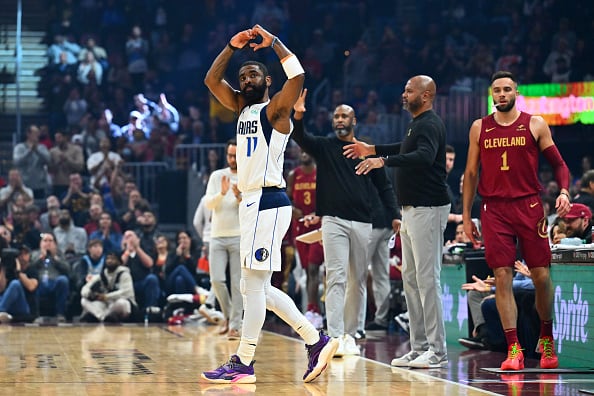
Cleveland, Ohio Eight years after the event, Kyrie Irving is still battling the media’s portrayal of his departure from Cleveland.
Host Ethan Sands and columnist Jimmy Watkins of cleveland.com discuss Irving’s recent remarks and the continuous struggle between athletes and the media for control of their narratives in the most recent episode of Wine and Gold Talk.
Sands was drawn to Irving’s bold statement on his most recent Twitch stream: “You guys will hear the real story when I’m done playing.”
This assertion implies that there is more to the LeBron-Kyrie story than has been publicized, which obviously wore Watkins down.
In a direct response, Watkins said, “This is where Kyrie loses me.” He comes across as quite defensive. Since there were some LeBron sycophants, particularly when he first returned to Cleveland, I can see why he could feel a little poisoned toward the media.
The podcast dives into the fascinating dynamic between athlete narratives and media coverage, with Irving serving as the perfect case study.
As they argue, no NARP would understand what it’s like to be under that much public scrutiny, even while they acknowledge the particular pressure Irving endured. Watkins also criticized Irving for his constant victimization.
What else can be said about LeBron and Kyrie? Watkins inquired. Do you people still give a damn about his reasons for leaving? Because I genuinely believe we comprehend it.
“I think when Kyrie says we’ll tell the story eventually, what Kyrie’s going to do is what a lot of players are doing these days, which is self-produce their own documentary where they put their own spin on their own careers and get a bunch of people who they know will say nice things about them and give the most flattering, their most flattering version of the truth about their career,” Watkins continued, offering a particularly scathing prediction about what Irving’s real story might look like.
The podcast discussion sheds light on the larger trend of athletes taking charge of their stories in direct reaction to what they see as unjust media coverage.
However, according to Watkins, this tendency can just substitute a biased story for another.
More Cavs coverage
-
Beyond buckets: How bad habits derailed Kyrie Irving s career in Cleveland
-
When stars collide: How sharing the spotlight transforms young guards
-
Can Darius Garland avoid the same mistakes that drove Kyrie Irving out of Cleveland? Wine and Gold Talk podcast
The conversation is especially interesting because of how it compares to the Cavaliers’ current predicament.
Sands notes that although there were whispers that Garland may leave if Donovan Mitchell signed an extension, Garland has subsequently accepted his position.
According to Sands, Darius is taking the lessons he learned from Kyrie Irving’s past mistakes, applying them in the present, and benefiting from them because he isn’t committing the same ones.
The idea that the present Cavaliers could gain from learning from Irving’s mistakes gives the team’s developmental strategy an interesting new dimension.
Watkins interrupted the conversation with a scathing critique of Irving’s professional decisions: The story took a turn for the worst when [Irving] took the wheel and began narrating your own story. Whatever posturing he’s doing at the end of the Twitch stream, I simply can’t stand it.
Irving, for his part, insists that he has no ill will against LeBron.
“It’s not that I disliked playing with LeBron at any time,” Sands said in reference to the Twitch stream. Simply put, it was time for me to move on. And people have to accept that.
A surprising fact about contemporary sports is brought to light by the podcast discussion: occasionally, the backstories of a game can be just as interesting as the actual action.
The Cavaliers seem intent on making sure their current young star takes the appropriate lessons from that complex past, while Irving continues to struggle with media narratives.
This week’s podcast is available here:


