
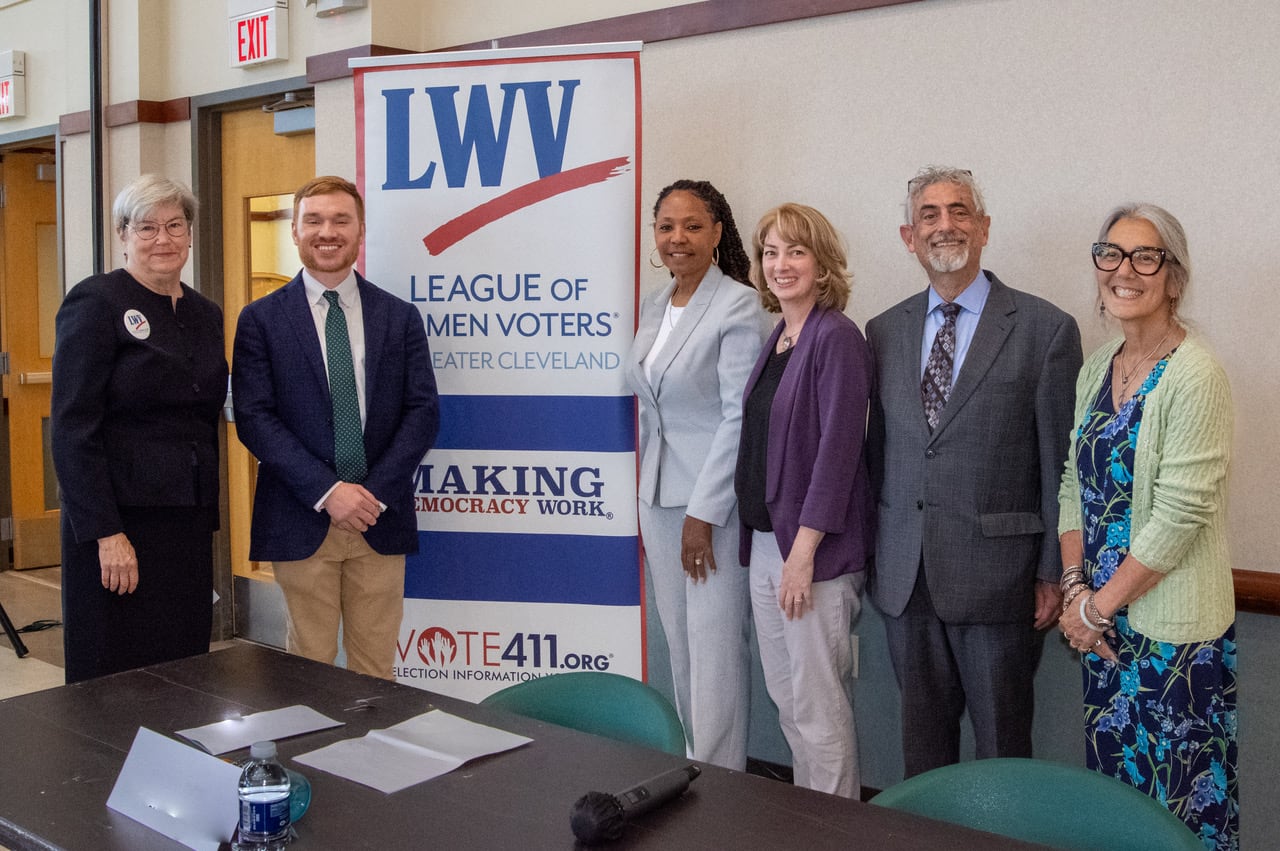
Ohio’s Cleveland Heights — Five contenders argued last week for moving on to the main election, with roughly a month until the city’s second-ever mayoral primary.
On November 4, the two most popular candidates will compete to become the city’s second elected mayor.
Wendy Deuring, moderator of the Heights League of Women Voters, noted the maximum crowd that filled the Cleveland Heights Community Center for the Aug. 7 event, noting that local elections always have the lowest voter turnout.
Deuring remarked, “I think that might be different this time (on election day).”
This is the appearance of democracy.
Due to a lack of valid signatures, incumbent Mayor Kahlil Seren was not included on the primary ballot.
On the same September 9 primary ballot, he is also up for recall.
The remaining five candidates, including two current members of the Cleveland Heights City Council, each made a brief opening and closing remark and responded to questions that Deuring read.
They are listed alphabetically as follows:
–Former Future Heights executive director Deanna Bremer Fisher has been University Heights Mayor Michael Dylan Brennan’s chief of staff and a significant policy adviser for nearly three years.
“In 2019, we voted for a change of government back in Cleveland Heights, but we didn’t vote for the mess we’re in,” Fisher added.
Now is the moment to hit the reset button.
She promised to develop an inclusive community and accomplish goals without causing any drama in Cleveland Heights.
I’ve been there and have done that, so I wouldn’t need to understand how local government operates, according to Fisher’s list of goals that she would present on Day One.
It consists of:
Restoring the public’s trust in local government
Severance Town Center Redevelopment
Rebuilding the infrastructure of the city
Reviving communities
To work on top priorities and other strategic projects, I need to hire and keep a talented city administrator.
Fisher noted the reconstruction of University Square in her current position, and she also launched the Future Homes rehabilitation program and the Heights Observer, followed by a modest grants program for community projects.
She would also establish a productive workplace for city workers.
–Marty Gelfand also contributes some cross-border experience.
“I learned how an elected mayor system is supposed to work over in South Euclid,” Gelfand added.
Additionally, it should function as co-equal branches of government.
He attended public schools and grew up in Cleveland Heights. After that, he spent six years in the Navy.
Gelfand obtained his law degree from Case Western Reserve University after completing his undergraduate studies at Annapolis’ St. John’s College and working as an environmental advocate in Washington, D.C.
He then became senior counsel to then-freshman Congressman Dennis Kucinich, with whom he served for the full 16-year term.
Gelfand spent 18 years in South Euclid, half of which he spent on the South Euclid City Council, where he chaired the Safety Committee for seven years, although still being in the Cleveland Heights-University Heights School District.
Since the charter makes no mention of Seren being a powerful mayor, Gelfand expressed his disappointment with Seren’s remarks.
Gelfand stated that he would not allow the council to speak with his department heads. But you don’t accomplish things that way.
In addition to being a member of the facilities committee for the Heights High and middle school construction projects, Gelfand has been an assistant prosecutor for Cuyahoga County since 2021.
–According to Laura Kingsley Hong, a Tucker-Ellis lawyer who has lived in Cleveland Heights for almost 40 years, City Hall’s culture needs to change.
Hong informed the audience, “I am not your candidate if you like what’s happening at City Hall.”
I am your option if you want a change agent who is an outsider with genuine management expertise and leadership.
She went on to say that we don’t need the expertise that some of the other candidates have with dysfunctional administration.
According to Hong, she just finished seven years of overseeing a team of 70 attorneys and paralegals with multimillion-dollar budgets while dealing with strict courts and lawyers.
According to Hong, this city needs a mayor who will occupy every empty lot, boost public revenue, and fight tooth and nail with unresponsive and absentee landlords to clean up our properties and assist the elderly and underprivileged inhabitants in maintaining our housing stock.
Fighting for the redevelopment of Severance will be another priority, and we will find another one if the developer’s interests do not coincide with the long- and short-term objectives of our city.
Returning to the culture shift, she stated that we require a mayor who would guide our city’s personnel and staff to provide excellent services to all of our neighbors in a fair way.
As he nears the halfway point of his first time on City Council, Jim Petrascited expressed his continued irritation, stating that he wants to begin by addressing the fundamentals, like patching potholes.
The CWRU IT project director, who holds an MBA from the Weatherhead School of Management, stated that we need a mayor with a track record of uniting people and completing tasks.
Without help from the unwilling government, Petras is credited with creating an interim budget virtually overnight to get the city through the first three months of this year.
His top goals are resurfacing streets, for which he suggested tripling capacity this year, as well as promptly clearing snow and improving parks, pools, and the Community Center to provide wonderful spaces for families to congregate.
According to Petras, he visits troublesome residences in the neighborhood every day and works to address problems that locals bring to his notice.
According to Petras, the council can only enact laws as much as it wants. However, the mayor bears the ultimate responsibility for completing tasks.
Delivering the essential city services that citizens demand and deserve will be my main priority if elected.
In contrast to previous gatherings that produced no results, he also intends to convene our community to vote on a viable plan for Cumberland Pool and actually see it through to completion.
–In 2019, Davida Russell, the current vice president of the City Council, received the most votes in the city and was elected to a two-year term.
Based on a strong feeling of advocacy and service, as well as the conviction that change begins with us, she has decided to run for mayor rather than compete for reelection when her current four-year term ends.
Russell started her own You Talk, I Listen community forums shortly after she took her position.
Additionally, she advocated for specific American Rescue Plan Act (ARPA) financing for business districts severely impacted by the pandemic, including the Noble and Taylor neighborhoods.
Seren’s $1.5 million ARPA contribution for the original Strampin Cain Park was met with minority disagreeing votes from Russell and current Council President Tony Cuda.
According to Russell, our community requires seasoned, caring leaders who can listen, bring people together, and achieve results.
Her family left the Collinwood area when she was a child in 1975 because we thought Cleveland Heights was a kind place.
She has thirty years of experience as an elected labor leader, a school bus driver, and a substitute teacher, which has given her a grasp of administrative authority, budgets, and contracts.
In 2021, Russell also established the Ohio Alliance of Community Education (Ohio ACE), a nonprofit organization.
The Cleveland Heights-University HeightsLWV chapter website has the written comments of the mayoral candidates.
In just three days, the tape of the August 7 mayoral candidates forum has received over 1,800 views. You can view it here: https://www.youtube.com/watch?v=z0-g48JfumM
See the Sun Press for further information.


